Reference Type Casting: Upcasting and Downcasting
Introduction
In Java, object references are static-typed at compile-time but dynamic-typed at runtime. To bridge compile-time definitions and runtime implementations, Java uses reference type casting.
Understanding Upcasting and Downcasting is essential to implement runtime polymorphism and access subclass-unique behaviors safely.
Real-World Analogy: Animals
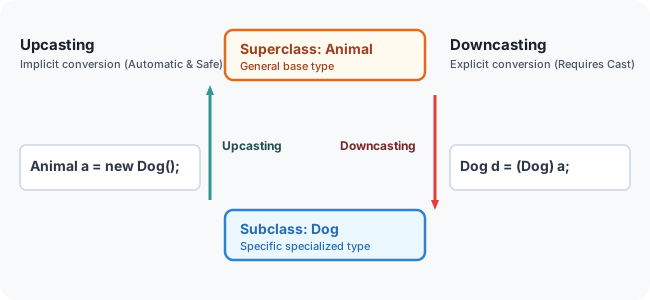
- Every Dog is an Animal. Therefore, converting a Dog reference to an Animal reference is implicit and safe.
- However, not every Animal is a Dog. It could be a Cat or a Lion. Converting a generic Animal reference to a specific Dog reference is unsafe and must be declared explicitly.
graph TD
    Animal[Animal Class]
    Dog[Dog Class]
    Animal -->|Implicit Casting: Upcasting| Dog
    Dog -.->|Explicit Casting: Downcasting| Animal
What is Upcasting?
Upcasting is casting a subclass object to a parent class reference. This is done implicitly by the compiler and is always safe.
Upcasting Example:
class Animal {
    public void eat() {
        System.out.println("Animal is eating.");
    }
}

class Dog extends Animal {
    public void bark() {
        System.out.println("Dog barks: Woof!");
    }
}

public class Main {
    public static void main(String[] args) {
        // Implicit upcasting: Dog reference assigned to Animal reference
        Animal animal = new Dog();
        animal.eat(); // Output: Animal is eating.
    }
}
What Can Be Accessed After Upcasting?
When a child object is upcast to a parent reference: * You can access all methods declared in the parent class. * You cannot access subclass-unique methods directly.
Animal animal = new Dog();
animal.eat();  // VALID - declared in Animal
animal.bark(); // COMPILER ERROR - cannot find symbol 'bark()' in Animal
Why?
The compiler determines member accessibility based on the reference variable type (Animal), not the runtime object type (Dog).
What is Downcasting?
Downcasting is casting a parent reference back to its subclass reference type. This must be performed explicitly, as it is potentially unsafe.
Why Downcast?
We use downcasting when we have a parent reference but need to access subclass-unique methods (e.g. calling bark() using an Animal reference).
Downcasting Example:
public class Main {
    public static void main(String[] args) {
        Animal animal = new Dog(); // Upcast

        // Explicit Downcast
        Dog dog = (Dog) animal;
        dog.bark(); // VALID - Output: Dog barks: Woof!
    }
}
Unsafe Downcasting & ClassCastException
If you attempt to downcast an object to a type it does not belong to, the JVM will throw a ClassCastException at runtime.
class Cat extends Animal {}

public class Main {
    public static void main(String[] args) {
        Animal animal = new Cat(); // animal is actually a Cat

        // Attempting to downcast Cat to Dog
        Dog dog = (Dog) animal; // Compiles fine, but throws ClassCastException at runtime!
        dog.bark();
    }
}
Safe Downcasting using instanceof
To prevent ClassCastException, always use the instanceof operator to verify the runtime object type before downcasting.
public class Main {
    public static void main(String[] args) {
        Animal animal = new Dog();

        if (animal instanceof Dog) {
            Dog dog = (Dog) animal; // Safe downcast
            dog.bark();
        } else {
            System.out.println("Casting aborted: Object is not a Dog.");
        }
    }
}
Upcasting vs. Downcasting
| Feature | Upcasting | Downcasting |
|---|---|---|
| Direction | Subclass to Superclass (Child \(\rightarrow\) Parent) | Superclass to Subclass (Parent \(\rightarrow\) Child) |
| Casting Syntax | Implicit / Automatic | Explicit (requires manual cast syntax) |
| Safety | Always safe | Unsafe (can throw ClassCastException) |
| Purpose | Enables runtime polymorphism | Accesses subclass-unique members |
Concept Map
graph TD
    Cast[Reference Casting]
    Cast --> Up[Upcasting: Child to Parent]
    Up --> Implicit[Automatic & Safe]
    Up --> Access1[Restricts access to parent members only]

    Cast --> Down[Downcasting: Parent to Child]
    Down --> Explicit[Manual & Unsafe]
    Down --> Instance[instanceof Check prevents ClassCastException]
    Down --> Access2[Unlocks child-specific members]
Interview Questions (FAQ)
Why is upcasting safe but downcasting unsafe?
Upcasting is safe because a subclass inherits all fields and methods from the parent class, guaranteeing their presence. Downcasting is unsafe because a parent reference might point to a different subclass (e.g. an Animal reference pointing to a Cat cannot be cast to a Dog).
What exception is thrown on invalid downcasting?
java.lang.ClassCastException is thrown.
Can we bypass compiler checks during downcasting?
No. The compiler requires an explicit cast syntax (Subclass) reference to acknowledge that you are taking responsibility for casting safety.
Practice Challenges
- Multimedia Player: Create a base class
Mediaand subclassVideo. Add a subclass-unique methodplayVideo(). Upcast aVideoobject to aMediareference. Then, safely downcast it back usinginstanceofto callplayVideo(). - Staff Hierarchy: Design a
Staffbase class and aProfessorsubclass. AddgiveLecture()toProfessor. Demonstrate safe downcasting from aStaffreference to triggergiveLecture().
Key Takeaways
- Upcasting converts a child reference to a parent reference type. It is implicit, safe, and powers runtime polymorphism.
- Downcasting converts a parent reference back to a child reference type. It is explicit and can throw a
ClassCastException. - Always use
instanceofto check the runtime object type before downcasting. - Casting reference variables changes the compile-time visibility of members, not the underlying object type on the Heap.
Back to Module Home: Object-Oriented Programming