Runtime Polymorphism in Java
Introduction
In previous guides, we explored Compile-Time Polymorphism (early binding resolved via method overloading).
This guide examines Runtime Polymorphism, where method calls are bound to their implementations during program execution rather than compilation. Runtime polymorphism is the core mechanism that allows Java to execute subclass-specific behaviors dynamically.
This mechanism is also known as: * Dynamic Polymorphism * Late Binding * Dynamic Method Dispatch
What is Runtime Polymorphism?
Runtime Polymorphism is the capability by which a call to an overridden method is resolved at runtime. It is implemented in Java by combining three distinct concepts: 1. Inheritance: Subclasses must inherit from a common parent class. 2. Method Overriding: Subclasses must provide their own custom implementations of a method declared in the parent class. 3. Upcasting (Parent Reference, Child Object): A reference variable of the parent class must point to a subclass object.
graph TD
    RunPoly[Runtime Polymorphism]
    RunPoly --> Inherit[1. Class Inheritance]
    RunPoly --> Override[2. Method Overriding]
    RunPoly --> Upcast[3. Parent Ref -> Child Instance]
Core Mechanics: Method Overriding Rules
For a subclass to successfully override a parent method and trigger runtime polymorphism: * The subclass method must share the exact same name as the parent method. * The subclass method must declare the exact same parameter list (signatures must match). * The subclass method's return type must be the same (or a subtype, known as a covariant return type). * The access modifier of the overriding method cannot be more restrictive than the parent method (e.g. if the parent method is protected, the child method must be protected or public).
Runtime Polymorphism Example
Here is a complete program demonstrating dynamic binding.
// Superclass
class Animal {
    public void sound() {
        System.out.println("Animal makes a general sound.");
    }
}

// Subclass A
class Dog extends Animal {
    @Override
    public void sound() {
        System.out.println("Dog barks: Woof!");
    }
}

// Subclass B
class Cat extends Animal {
    @Override
    public void sound() {
        System.out.println("Cat meows: Meow!");
    }
}

public class Main {
    public static void main(String[] args) {
        Animal animal; // Parent Reference Variable

        animal = new Dog(); // Reference points to Dog object on Heap
        animal.sound();     // Output: Dog barks: Woof!

        animal = new Cat(); // Reference points to Cat object on Heap
        animal.sound();     // Output: Cat meows: Meow!
    }
}
Why does Dog.sound() execute?
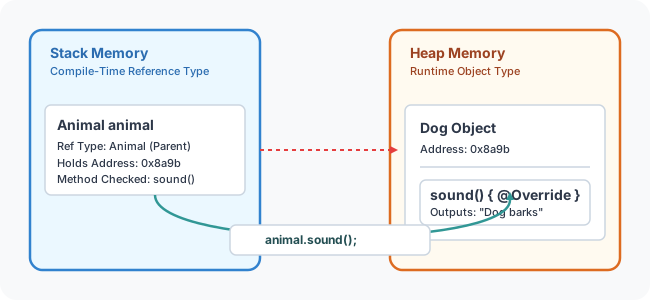
Even though the compile-time type of the variable animal is Animal, the JVM inspects the actual object type in Heap memory when executing animal.sound(). Since the object is an instance of Dog (or Cat), the overridden method inside Dog (or Cat) is dispatched.
Dynamic Method Dispatch
Dynamic Method Dispatch is the name of the execution-time algorithm that resolves overridden method calls. The JVM locates the correct method inside the subclass's method table (vtable) dynamically.
Crucial Rule: Variables are NOT Polymorphic
While method invocations participate in late binding, instance variables do not. Variable resolution is determined strictly by the compile-time reference type (Static Binding).
class Animal {
    String name = "Generic Animal";
}

class Dog extends Animal {
    String name = "Dog";
}

public class Main {
    public static void main(String[] args) {
        Animal animal = new Dog();
        System.out.println(animal.name); // Prints "Generic Animal", NOT "Dog"!
    }
}
Output:
Constructors and Runtime Polymorphism
Constructors cannot be overridden. A constructor is tied to a specific class definition and is never inherited by subclasses. Therefore, constructors cannot participate in runtime polymorphism.
class Parent {
    public Parent() {} // Constructor
}

class Child extends Parent {
    // INVALID - Compile error
    @Override
    public Parent() {}
}
Compile-Time vs. Runtime Polymorphism
| Parameter | Compile-Time Polymorphism | Runtime Polymorphism |
|---|---|---|
| Technique | Method Overloading | Method Overriding |
| Binding Mechanism | Early Binding / Static Binding | Late Binding / Dynamic Binding |
| Execution Speed | Faster execution (binding resolved at compile-time) | Slightly slower (method lookup occurs at runtime) |
| Inheritance Requirement | Not required | Mandatory |
Advantages of Runtime Polymorphism
- Plug-and-Play Extensibility: New subclasses can be written and plugged into existing codebases with zero adjustments to calls referencing the parent.
- Loose Coupling: Client programs interact with general interfaces rather than hardcoding child dependencies.
- Code Cleanliness: Replaces cluttered
if-elseorswitchtype checks (e.g. checking whether a vehicle is a car, truck, or bike) with a single polymorphic call (vehicle.start()).
Concept Map
graph TD
    Late[Runtime Polymorphism]
    Late --> Over[Method Overriding]
    Late --> Upcast["Upcasting: Parent ref = new Child()"]
    Late --> Dispatch[Dynamic Method Dispatch]
    Dispatch --> Check[JVM checks Heap object type]
    Check --> Exec[Executes subclass overridden method]
Interview Questions (FAQ)
What is dynamic method dispatch?
It is the runtime mechanism by which the JVM resolves calls to overridden methods, executing the implementation corresponding to the actual instance on the Heap.
Can static methods be overridden?
No. Static methods belong to the class namespace, not object instances. Redefining a static method in a subclass hides the parent method, which is known as Method Hiding, and does not support late binding.
What is a covariant return type in overriding?
It allows an overriding subclass method to return a subtype of the return type declared in the parent method. For example, if a parent method returns Animal, the overridden child method can return Dog.
Practice Challenges
- Shape Area Calculator: Create a base class
Shapewith a methodcalculateArea(). Extend it with subclassesCircle(needs radius) andRectangle(needs width/height). OverridecalculateArea()in each subclass. Use a parentShapereference array to compute and display areas for different shapes. - Device Remote System: Define a
Devicesuperclass with a methodturnOn(). Extend it withTelevisionandAirConditionersubclasses. Demonstrate dynamic dispatch by invokingturnOn()on different device instances.
Key Takeaways
- Runtime polymorphism relies on method overriding and upcasting.
- Overridden method execution is resolved at runtime based on the actual object type in the Heap.
- Instance variables are not polymorphic; they are resolved based on the compile-time reference type.
- Constructors cannot be overridden.
Back to Module Home: Object-Oriented Programming