Inheritance in Java
Introduction
Inheritance is one of the four core pillars of Object-Oriented Programming (OOP), alongside Encapsulation, Polymorphism, and Abstraction. It is a mechanism that allows a new class (subclass) to inherit the state (fields) and behavior (methods) of an existing class (superclass).
By establishing relationships between classes, inheritance enables code reuse, reduces redundancy, and forms the basis for runtime polymorphism.
What is Inheritance?
Inheritance models an IS-A relationship between classes. It is the connection between a general class (parent) and a specialized class (child).
Examples:
- A
DogIS-AAnimal. - A
CarIS-AVehicle. - A
StudentIS-APerson.
Why Do We Need Inheritance?
Consider a scenario without inheritance where you write code for different animal types:
class Dog {
    String name;
    public void eat() {
        System.out.println("Eating food...");
    }
}

class Cat {
    String name;
    public void eat() {
        System.out.println("Eating food...");
    }
}
This design leads to duplicate code. If you have fifty different animal classes, you would have to copy and paste the name field and the eat() method fifty times.
The Inheritance Solution:
We factor out the common states and behaviors into a single, shared parent class (Animal) and extend it:
class Animal {
    String name;
    public void eat() {
        System.out.println("Eating food...");
    }
}

// Inherit common fields and methods
class Dog extends Animal {}
class Cat extends Animal {}
Now, both Dog and Cat automatically inherit name and eat(), eliminating code duplication.
Parent Class vs. Child Class
An inheritance relationship consists of two classes: 1. Superclass (Parent / Base Class): The class whose properties and methods are inherited. 2. Subclass (Child / Derived Class): The class that inherits properties from the superclass. A subclass can add its own unique variables and methods in addition to those inherited.
graph TD
    Parent["Superclass / Parent Class"] -->|Inherited by| Child["Subclass / Child Class"]
Syntax
In Java, inheritance is implemented using the extends keyword:
First Inheritance Program
Here is a complete executable program demonstrating a subclass inheriting a method from its superclass.
// Superclass
class Animal {
    public void eat() {
        System.out.println("Animal is eating.");
    }
}

// Subclass
class Dog extends Animal {
    // Inherited eat() is implicitly present here
}

public class Main {
    public static void main(String[] args) {
        Dog myDog = new Dog();
        myDog.eat(); // Invokes the inherited eat() method
    }
}
Output:
Method Lookup Mechanics:
When myDog.eat() is invoked, the JVM performs a lookup: 1. It searches the Dog class for the eat() method. 2. Since eat() is not found locally, the JVM traverses up the hierarchy to the parent Animal class. 3. The method is found in the Animal class and executed.
Types of Inheritance Supported in Java
Java supports three primary types of inheritance using classes:
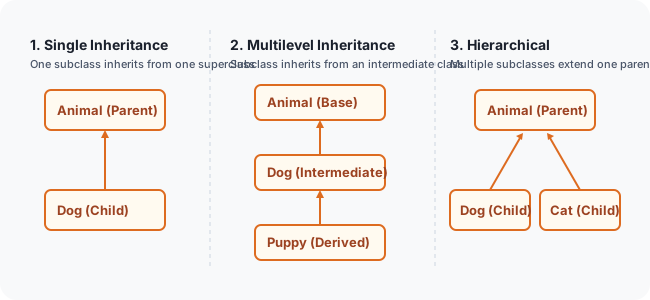
1. Single Inheritance
A subclass inherits from a single superclass.
2. Multilevel Inheritance
A subclass inherits from a parent class, which in turn inherits from another grandparent class.
3. Hierarchical Inheritance
Multiple subclasses extend a single parent class.
Multiple Inheritance Restriction in Java
Java does not support multiple inheritance with classes. A single class cannot extend more than one class:
Why is Multiple Inheritance Blocked?
This restriction prevents the Diamond Problem (ambiguity). If class A and class B both contain a method with the same signature print(), and class C extends both, calling c.print() would cause ambiguity because Java wouldn't know which parent's implementation to execute. To avoid this, Java supports multiple inheritance only through Interfaces.
Constructors under Inheritance
When you instantiate a child class object, the parent class constructor executes first, followed by the child class constructor.
class Animal {
    public Animal() {
        System.out.println("Animal (Parent) Constructor Executed");
    }
}

class Dog extends Animal {
    public Dog() {
        // super(); is implicitly called here by the compiler
        System.out.println("Dog (Child) Constructor Executed");
    }
}

public class Main {
    public static void main(String[] args) {
        Dog d = new Dog();
    }
}
Output:
The Object Class: The Universal Ancestor
Every class in Java that does not explicitly extend another class implicitly extends java.lang.Object. The Object class is the root of the entire Java class hierarchy.
graph TD
    Obj[java.lang.Object] -->|Implicitly Extended| Animal[Animal Class]
    Animal -->|Explicitly Extended| Dog[Dog Class]
Because of this, every class in Java inherits fundamental methods like toString(), equals(), and hashCode().
Inheritance vs. Composition
| Metric | Inheritance | Composition |
|---|---|---|
| Relationship | IS-A relationship | HAS-A relationship |
| Syntax | Class signature uses extends | Field references instances of other classes |
| Binding | Compile-time (Static binding) | Runtime (Dynamic binding) |
| Coupling | Tight coupling | Loose coupling |
Concept Map
graph TD
    Inherit[Inheritance: IS-A]
    Inherit --> Single[Single: One parent, one child]
    Inherit --> Multilevel[Multilevel: Chained grandparent-parent-child]
    Inherit --> Hierarchical[Hierarchical: Multiple children, one parent]
    Inherit --> Rules[Rules: No Multiple Inheritance with Classes]
    Inherit --> Const[Constructors: Parent constructor runs first]
Interview Questions (FAQ)
What is inheritance?
Inheritance is the OOP mechanism where a subclass inherits fields and behaviors from a parent superclass.
Which keyword is used to implement inheritance?
The extends keyword is used.
Why does Java not support multiple inheritance with classes?
To prevent the ambiguity known as the Diamond Problem, where a subclass inherits conflicting method implementations from multiple parents.
Practice Challenges
- Person-Student Hierarchy: Create a
Personclass with fieldsnameandage. Create aStudentsubclass extendingPersonwith a uniquegradefield. Implement a method inStudentthat prints all three fields. - Vehicle Classification: Create a
Vehiclebase class with a methodhonk(). Extend it with aCarsubclass. Callhonk()using aCarobject.
Key Takeaways
- Inheritance represents an
IS-Arelationship. - Subclasses reuse code from parent classes, reducing code duplication.
- Subclass constructors implicitly call their parent constructor (
super()) on the first line. - Java supports Single, Multilevel, and Hierarchical inheritance, but rejects Multiple inheritance with classes.
Back to Module Home: Object-Oriented Programming