Composition in Java
Introduction
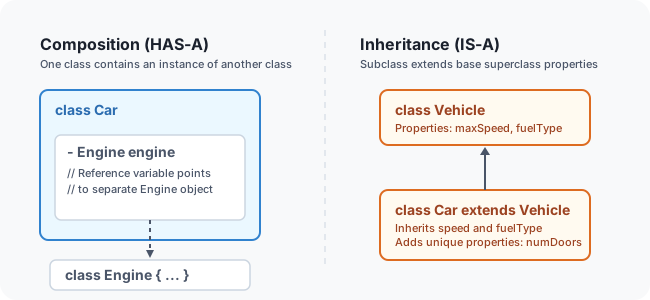
In Object-Oriented Programming (OOP), modeling relationships between different classes is a core task. While Inheritance represents an IS-A relationship (e.g., a Car is a Vehicle), Composition represents a HAS-A relationship.
Composition is a design technique where one class contains reference variables pointing to objects of other classes as instance variables. This allows us to build complex objects by combining simpler, specialized objects.
Real-World Analogy: The Computer
A real-world computer is not a single, indivisible entity. It is composed of multiple specialized components working together:
- A Computer HAS-A Monitor
- A Computer HAS-A Keyboard
- A Computer HAS-A Motherboard
- A Computer HAS-A Processor
In Java, instead of writing all keyboard and monitor fields inside the Computer class, we design separate Keyboard and Monitor classes and include them as fields inside the Computer class.
Composition vs. Inheritance
Inheritance (IS-A)
Inheritance is used when a subclass is a specialized version of a superclass.
Composition (HAS-A)
Composition is used when a class contains other objects to construct its state.
Why Use Composition?
Using composition over deep inheritance hierarchies offers several key advantages: * Code Reusability: Components like an Address class can be reused across different classes (e.g., Customer, Employee, Supplier). * Flexibility: The internal object implementation can be replaced or updated at runtime. * Low Coupling: Changing the internal code of the component class (e.g., Engine) does not break the container class (Car). * Avoids Fragile Base Class Problem: Deep inheritance chains make sub-classes highly fragile to parent modifications. Composition avoids this.
Basic Composition Example
Here is a basic program showing a Car containing a reference to an Engine object.
Class Definitions:
class Engine {
    public void start() {
        System.out.println("Engine started. Vroom!");
    }
}

class Car {
    private Engine engine; // HAS-A relationship

    public Car() {
        // Instantiate the dependent object inside the constructor
        this.engine = new Engine();
    }

    public void startCar() {
        engine.start(); // Delegating behavior
        System.out.println("Car is ready to drive.");
    }
}
Main Class Execution:
public class Main {
    public static void main(String[] args) {
        Car myCar = new Car();
        myCar.startCar();
    }
}
Output:
Memory Representation
When you instantiate a container object, memory is allocated on the Heap for the container, which contains references pointing to separate child objects on the Heap.
graph LR
    StackRef[Stack Reference: myCar] -->|points to| HeapCar[Car Object in Heap]
    HeapCar -->|engine field points to| HeapEngine[Engine Object in Heap]
Composition with Multiple Component Classes
Let's look at a computer model composed of a separate Monitor and Keyboard.
class Monitor {
    public void display() {
        System.out.println("Display rendering pixels.");
    }
}

class Keyboard {
    public void type() {
        System.out.println("Keyboard sending key inputs.");
    }
}

class Computer {
    private Monitor monitor;
    private Keyboard keyboard;

    public Computer() {
        this.monitor = new Monitor();
        this.keyboard = new Keyboard();
    }

    public void bootSystem() {
        monitor.display();
        keyboard.type();
        System.out.println("Computer booted and ready for use.");
    }
}

public class Main {
    public static void main(String[] args) {
        Computer pc = new Computer();
        pc.bootSystem();
    }
}
Output:
Composition via Constructor Injection
Instead of instantiating components directly inside the constructor (which hard-codes the dependency), it is often better design to pass pre-created component objects into the constructor. This is called Constructor Dependency Injection.
class Engine {
    public void start() {
        System.out.println("Engine started.");
    }
}

class Car {
    private Engine engine;

    // Engine is injected from the outside
    public Car(Engine engine) {
        this.engine = engine;
    }

    public void drive() {
        engine.start();
        System.out.println("Driving...");
    }
}

public class Main {
    public static void main(String[] args) {
        Engine V8 = new Engine();
        Car muscleCar = new Car(V8); // Injecting V8 engine
        muscleCar.drive();
    }
}
Real-World Banking Example
In enterprise applications, data models are heavily composed. For example, a Customer has a contact Address.
class Address {
    private String city;

    public Address(String city) {
        this.city = city;
    }

    public String getCity() {
        return city;
    }
}

class Customer {
    private String name;
    private Address address; // Composition

    public Customer(String name, Address address) {
        this.name = name;
        this.address = address;
    }

    public void displayCustomer() {
        System.out.println("Customer: " + name);
        System.out.println("City: " + address.getCity());
    }
}

public class Main {
    public static void main(String[] args) {
        Address addr = new Address("Chennai");
        Customer cust = new Customer("Sanjay", addr);
        cust.displayCustomer();
    }
}
Composition vs. Aggregation
While both represent HAS-A relationships, they differ in relationship strength:
1. Composition (Strong HAS-A)
The child object's lifecycle is bound to the parent object's lifecycle. The child cannot exist independently. * Example: A House has Rooms. If the house is demolished, the rooms cease to exist.
2. Aggregation (Weak HAS-A)
The child object can exist independently of the parent object. * Example: A Department has Teachers. If the department is closed down, the teachers still exist.
Common Mistakes
1. Inheriting when Composition is Appropriate
// WRONG - Car IS NOT an Engine
class Car extends Engine {}

// CORRECT - Car HAS AN Engine
class Car {
    private Engine engine;
}
2. Failing to check for Null Reference
If components are injected or uninitialized, calling methods on them directly will throw a NullPointerException.
class Car {
    private Engine engine; // Defaults to null

    public void start() {
        engine.start(); // Throws NullPointerException if V8 not passed!
    }
}
Concept Map
graph TD
    Comp[Composition]
    Comp --> HasA[HAS-A Relationship]
    HasA --> Ex1[Car HAS-A Engine]
    HasA --> Ex2[Computer HAS-A Monitor]
    HasA --> Ex3[Customer HAS-A Address]
Interview Questions (FAQ)
What is composition in Java?
Composition is a design technique in which a class contains reference variables pointing to instances of other classes as its fields, creating a HAS-A relationship.
What is the difference between inheritance and composition?
Inheritance is an IS-A relationship where a class inherits directly from a parent class. Composition is a HAS-A relationship where a class wraps instance variables of other class types.
Why is composition preferred over inheritance?
Composition provides better flexibility (components can be replaced at runtime), avoids multiple inheritance restrictions, does not expose parent implementation details to the outer scope, and reduces class coupling.
Practice Challenges
- Mobile Battery System: Create a
Batteryclass with fieldscapacity(int) andbrand(String). Create aMobilePhoneclass that contains aBatteryreference and outputs battery statistics. - Library Catalog: Create a
Bookclass containingtitleandauthor. Create aLibraryclass containing an array ofBookobjects. Implement a method displaying all book titles in the library.
Key Takeaways
- Composition represents a
HAS-Arelationship. - One class contains objects of other classes as member fields.
- Composition promotes looser coupling and higher runtime flexibility.
- Favor composition over inheritance whenever modeling system configurations or structural parts.
Back to Module Home: Object-Oriented Programming