Static vs Instance Members in Java
Introduction
When writing classes in Java, one of the most critical design decisions is determining whether a field or method should belong to the class template itself, or to individual object instances.
Java separates these scopes into two categories: * instance members (default): Belong to object instances. * static members: Belong to the class itself.
Understanding the difference is key to managing memory efficiency, variable sharing, and designing entry points (like main()).
graph TD
    Class[Class Members]
    Class --> Instance[Instance Members: Belong to Object]
    Class --> Static[Static Members: Belong to Class]

    Instance --> I1[Separate copies in Heap]
    Static --> S1[Single shared copy in Metaspace/Method Area]
What is an Instance Member?
An Instance Member is a variable or method declared without the static keyword. * Instance Variables: Represent properties unique to each object. Every object allocated on the Heap maintains its own separate copy of these variables. * Instance Methods: Represent behaviors that interact with individual object states. They must be invoked on an active object reference.
Example: Individual Student Names
Usage:
Student s1 = new Student();
Student s2 = new Student();

s1.name = "Sanjay";
s2.name = "Rahul";

System.out.println(s1.name); // Output: Sanjay
System.out.println(s2.name); // Output: Rahul
s1.name has no effect on s2.name because they point to completely separate memory blocks on the Heap. What is a Static Member?
A Static Member is a variable, method, or block marked with the static keyword. * Static Variables: Also known as class variables. Only a single copy of a static variable is allocated in the Metaspace (Method Area) of the JVM, regardless of how many object instances are created. All instances share this single copy. * Static Methods: Also known as class methods. They can be invoked directly using the class name, without allocating or referring to any object instance.
Example: Shared College Name
Usage:
// Accessed directly using the Class name:
System.out.println(Student.college); // Output: KGISL Institute of Technology
Memory Representation: Metaspace vs. Heap
In the JVM, static variables live in a separate memory area (Metaspace/Method Area), while objects and their instance variables live in the Heap.
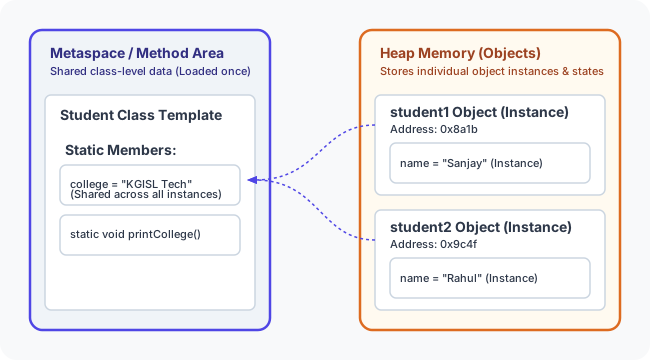
Memory Efficiency:
If a class has 1,000 objects, and each object contains a duplicate string literal "KGISL", it wastes memory. By making it static, only one string reference is created in the class template scope, reducing the Heap footprint of all 1,000 objects.
Static Blocks
A Static Block (or static initialization block) is a block of code enclosed in curly braces prefixed by the static keyword. It is executed automatically by the JVM once when the class is loaded into memory, before any constructors run or objects are instantiated. It is typically used to initialize complex static variables.
class DatabaseConfig {
    static String dbUrl;
    static int port;

    // Static initialization block
    static {
        System.out.println("Loading database configuration...");
        dbUrl = "jdbc:mysql://localhost:3306/mydb";
        port = 3306;
    }
}
Practical Static Pattern: Object Counter
One of the most common applications of static variables is tracking the number of instances created for a class.
class Employee {
    private String name;
    // Shared counter across all objects
    public static int employeeCount = 0;

    public Employee(String name) {
        this.name = name;
        employeeCount++; // Increments the shared counter
    }
}

public class Main {
    public static void main(String[] args) {
        new Employee("Sanjay");
        new Employee("Arun");
        new Employee("Rahul");

        // Access via the Class name
        System.out.println("Total Employees: " + Employee.employeeCount); // Output: 3
    }
}
Static vs. Instance Variable Comparison
| Feature | Static Variables | Instance Variables |
|---|---|---|
| Scope | Belongs to the Class | Belongs to individual Objects |
| Memory Allocation | Allocated once when class is loaded | Allocated on Heap every time new runs |
| Number of Copies | Exactly one shared copy | One copy per object instance |
| Access | Via ClassName.variableName | Via objectReference.variableName |
Static vs. Instance Method Comparison
| Feature | Static Methods | Instance Methods |
|---|---|---|
| Scope | Belongs to the Class | Belongs to the Object |
| Object Required | No object required to invoke | Must be called on an object reference |
| Access to Fields | Can only access other static fields directly | Can access both static and instance fields |
Use of this / super | Cannot use this or super | Can use this and super keywords |
Critical Access Rule
[!IMPORTANT] A static method cannot access instance variables or call instance methods directly. Because static methods execute without any object context, Java does not know which object's state to read.
Wrong (Compilation Error):
class Student {
    String name = "Sanjay"; // Instance variable

    public static void printName() {
        System.out.println(name); // COMPILER ERROR: non-static variable cannot be referenced from static context
    }
}
Correct:
To access instance fields inside a static method, you must explicitly instantiate or pass an object reference:
class Student {
    String name = "Sanjay";

    public static void printName(Student s) {
        System.out.println(s.name); // Correct - accessed via reference
    }
}
Why is the main() Method Static?
The entry point of any Java program is:
Themain() method must be static because the JVM needs to start executing the program before any objects are created. If main() were an instance method, Java would have a "chicken-and-egg" problem: it would need to create an object of the class to run main(), but it wouldn't know how or where to start the program without running main() first. Common Mistakes
1. Calling Static Members on Object Instances
Although Java allows accessing static variables via object references (e.g., s1.college), it is considered poor coding style. It hides the fact that the member is static, leading developers to think it is instance-specific. Always access static members via the Class name: Student.college.
2. Accessing this inside Static Contexts
public static void display() {
    System.out.println(this.hashCode()); // Compiler Error: 'this' cannot be referenced from static context
}
Interview Questions (FAQ)
Can we overload static methods?
Yes, static methods can be overloaded just like instance methods.
Can static methods be overridden?
No, static methods belong to the class, not object instances. While you can declare a static method in a subclass with the same signature, this is called Method Hiding, not overriding.
When should a method be declared static?
A method should be declared static when it does not depend on the state (instance variables) of any individual object. Excellent examples are utility methods like Math.sqrt() or Arrays.sort().
Practice Challenges
- Static Counter: Write a
Productclass withidandname. Automatically assign a unique sequential ID to each product using a private static counter that increments inside the constructor. - Calculator Utility: Create a
MathUtilsclass with static methodssquare(double),cube(double), and a static constantdouble PI. Execute them in a separate runner class without creating aMathUtilsobject. - Company Template: Build a
Companyclass with a static fieldcompanyNameand instance fieldsemployeeNameandsalary. Add a static method to updatecompanyName.
Key Takeaways
- Static members belong to the class; Instance members belong to objects.
- Static variables have one shared copy in JVM memory, saving memory for common constants or configurations.
- Static methods cannot access non-static variables or methods directly.
- Static blocks are run exactly once when the class is loaded.
- The
main()method must be static to run before any objects are created.
Back to Module Home: Building Blocks of Java