Control Flow Statements in Java
This module details Java's control structures: conditional branching (if-else, switch-case), looping statements (for, while, do-while), and logical loops challenges.
Learning Objectives
By the end of this module, you will be able to: * Implement conditional checks using if, else if, and else statements. * Construct multi-way branches using switch statements and avoid fall-through errors. * Differentiate between count-controlled loops (for) and condition-controlled loops (while, do-while). * Trace and explain pre-test versus post-test loop execution flows. * Optimize loop processing using branching keywords (break, continue). * Build complex numeric and modular logic (e.g., prime checks, digit extraction).
Topics Index
Below is the directory map of the lessons contained in this module:
| Lesson File | Core Concepts Covered | Link |
|---|---|---|
| 01. If Statement | Basic single-condition evaluations, truth-value routing. | Open Guide |
| 02. If-Else Statement | Binary decision forks, else-if ladders, nested structures. | Open Guide |
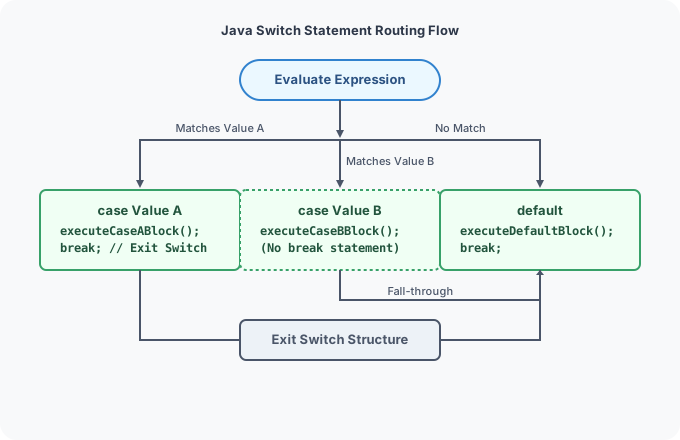
| 03. Switch Statement | Switch routing, case evaluation, break keywords, fall-through features. | Open Guide |
| 04. For Loop | Counter-controlled loops, initialization, loop parameters. | Open Guide |
| 05. For Loop Advanced | Nested loop patterns, multi-variable loops, break/continue scopes. | Open Guide |
| 06. Prime Numbers Challenge | Optimizing loops to check number factors, using early loop exit flags. | Open Guide |
| 07. Sum of Even Numbers Challenge | Accumulator loops, checking evens via modulo inside loops. | Open Guide |
| 08. While Loop | Pre-test iteration mechanics, execution conditional flags. | Open Guide |
| 09. Do-While Loop | Post-test iteration mechanics, guarantee of executing at least once. | Open Guide |
| 10. Number-Based Loop Challenges | Digit extraction algorithm, loop accumulation logic. | Open Guide |
Core Theory Summary
1. Conditionals: If-Else vs. Switch
- If-Else Ladders: Best for range checks (e.g.,
score > 90), complex logic evaluations (using&&,||), or checking boolean states. - Switch Statements: Best for evaluating a single variable against multiple discrete values (integers, strings, enums). It is highly optimized by the JVM using jump tables.
2. Loops: For vs. While vs. Do-While
flowchart TD
    Start[Loop Evaluation] --> Q{Is count known?}
    Q -- Yes --> For[Use 'for' Loop]
    Q -- No --> Q2{Must execute at least once?}
    Q2 -- Yes --> Do[Use 'do-while' Loop]
    Q2 -- No --> While[Use 'while' Loop]
Comparison of Loop Types
| Loop Type | Evaluation Timing | Execution Guarantee | Best Use Case |
|---|---|---|---|
for | Pre-test (before entering block) | 0 or more times | Iterating a fixed number of times (e.g. counters, array indexing). |
while | Pre-test (before entering block) | 0 or more times | Iterating until a specific condition becomes false (e.g. read streams). |
do-while | Post-test (after running block) | 1 or more times | Running code that must execute at least once (e.g. user menus). |
Best Practices for Control Flow
- Use Braces
{}Always: Even for single-line statements insideifor loops, always write braces to prevent logical errors during code modification. - Avoid Nested Loops Where Possible: Nested loops increase time complexity exponentially (\(O(n^2)\)). Try to extract inner loops into helper methods or optimize data structures.
- Use Switch Breaks: Always include
break;in switch cases unless you are intentionally implementing a fall-through design. Document fall-throughs explicitly. - Prevent Infinite Loops: Ensure loop conditions contain updating variables (e.g. index increments, buffer reads) that eventually evaluate to
false.
Next Module: Let's learn about classes, variables scope, and class members in 05_building-blocks-of-java